Tag Archives: natural plaster

Clay Finish Plasters

Natural clay plaster finish at Canada's Greenest Home

Red wall almost finished

Natural clay finish plasters add an unparalleled beauty to any home, and it was exciting to apply these plasters to Canada’s Greenest Home this weekend.

These skim coat plasters can be applied over any wall surface. In this project, we used them over clay base coat plasters and over drywall.

The plasters are mixed on site using widely available and affordable materials. Clay, sand, calcium carbonate, pigment, flour paste and water are mixed together and applied to the wall by trowel in a single, thin coat (~1/8 inch).

Our typical formula is 10 parts clay, 4 parts sifted sand, 1 part calcium carbonate, 1 part flour paste (a natural glue/hardener) and ~3.5 parts water. Natural pigments are added to this mix by weight, based on trial samples made in advance. As with baking, the dry ingredients are mixed together and then added into the water, flour paster and pigment that have been blended.

The clay in this case is Tile 6 Kaolin, from a pottery supply store. We’ve used other kaolins and ball clays with similar results. Calcium carbonate is finely ground limestone, from Omya in Perth, Ontario. Flour paste is cooked by boiling 4 parts water and adding a mixture of 2 parts cold water and 1 part flour and boiling until thick. Our natural pigments come from Kama Pigments.

Helping us with the mixing and application was our good friend Mike Henry, a plasterer with Camel’s Back Construction. His attention to detail helps bring out the best in the clay plaster.

There is nothing like the depth, richness of colour, sound attenuation and warmth of a natural clay finish plaster!

Open House for Canada’s Greenest Home

Join us on Saturday, March 9, 10am – 4pm!

Canada's Greenest Home nears completion

Canada’s Greenest Home nears completion


We have attempted to build the most sustainable home possible, and want to share the results with you! Since April, 2012, the students and faculty of The Endeavour Centre have been working on creating a home that showcases the best in sustainable new construction, and we’re excited to open the doors and show you what we’ve created. Come and see a wide range of sustainable materials and systems, including straw bale walls, clay plasters, Durisol foundation, triple glazed windows, composting toilets, rainwater harvesting and treatment, air source heat pump, ERV, comprehensive energy monitoring, solar hot water, non-toxic finishes and much, much more
Progress Gallery
We hope you’ll come and take a tour at 136 1/2 James Street, Peterborough, Ontario
You can follow the progress of the entire project on our blog

Tadelakt Plaster for Beginners

February 16, 2013

Workshop Instructor(s):
Mike Henry — Natural Plasterer

Workshop Descriptionendeavour_tadelakt_052_2

Tadelakt is a natural plaster method that originates in Morocco and is the only type of natural plaster that is inherently waterproof, making it ideal for bathrooms, kitchens, showers, tubs and sinks. It is a beautiful plaster with an unequalled shiny finish and variegated colouring that is pleasing to the eye and to the touch.

This one-day introduction to tadelakt plastering will help beginners understand the materials and the techniques for making and applying tadelakt plaster. The workshop will show you how to source the materials required to make your own tadelakt mix, and how to make the mix and tint it.

The secret to tadelakt plastering is in the application. Applying tadelakt is a multi-stage process that requires patience and understanding of the material. Working on a small scale, this workshop will introduce you to the tadelakt process and give you the chance to take a small tadelakt project from start to shining finish.

Entry Requirements

Open to all

Fee

$125

Maximum class size: 12


Artistic Clay Plaster Finishes Workshop

January 20, 2013 **Workshop Cancelled**

We will attempt to reschedule this workshop in March

Workshop Instructor(s): Anna Wolfson
Anna Wolfson Design

Workshop DescriptionIMG_7262-768x1024

Beautiful accent walls can be created using natural materials like clay, sand, pigment and mica, and Anna Wolfson is a master of teasing out the best possible results from the natural finishes palette.

In this workshop, Anna will show participants how to use a number of widely available, natural and healthy materials to create a wealth of different finishes. Whether you are remodelling a room or building a whole new house, you will be able to apply Anna’s techniques to your home with amazing results.

If you have ever wanted to bring the warmth, beauty and unmatched feel of natural materials into your home, this is the workshop for you!

Entry Requirements

Open to all

Fee

$125

Maximum class size: 12

Burlap-powder-21

skip trowel

Low-tech glory: Straw and clay

A lot of the attention in a sustainable building goes to the high tech equipment and mechanical systems. But at the heart of a project like Canada’s Greenest Home are some wonderfully simple, low tech and extremely effective structural systems like our clay plastered straw bale walls.

The north wall bales are installed and ready for plastering. The wall studs at 34 inches on centre are visible between the bales.

Installing the straw bale walls on the north side of our building and coating them in clay plaster is a strategy that combines low cost with high performance, and provides a window to a building system that is competitive with current energy-intensive practices but is also feasible in a world with a lot less fossil fuels to expend. These are materials that are locally accessible in most settled regions of the world, and the fact that one can base a very energy efficient home on them gives hope for a future when other materials may be much costlier or no longer available to us.

We installed our bales into a double frame wall system that mimics conventional frame walls, but with the studs placed at 34 inches on centre. In doing so, we create “bays” in the wall that are sized to the length of our straw bales, making bale stacking and plaster preparation very simple and straightforward. Unlike post and beam frames, no notching or cutting of bales is required, nor are heavy beams at the top of the wall. It is a very simple, very cost-effective manner to build a bale wall, and one that many professional bale builders find themselves gravitating toward.

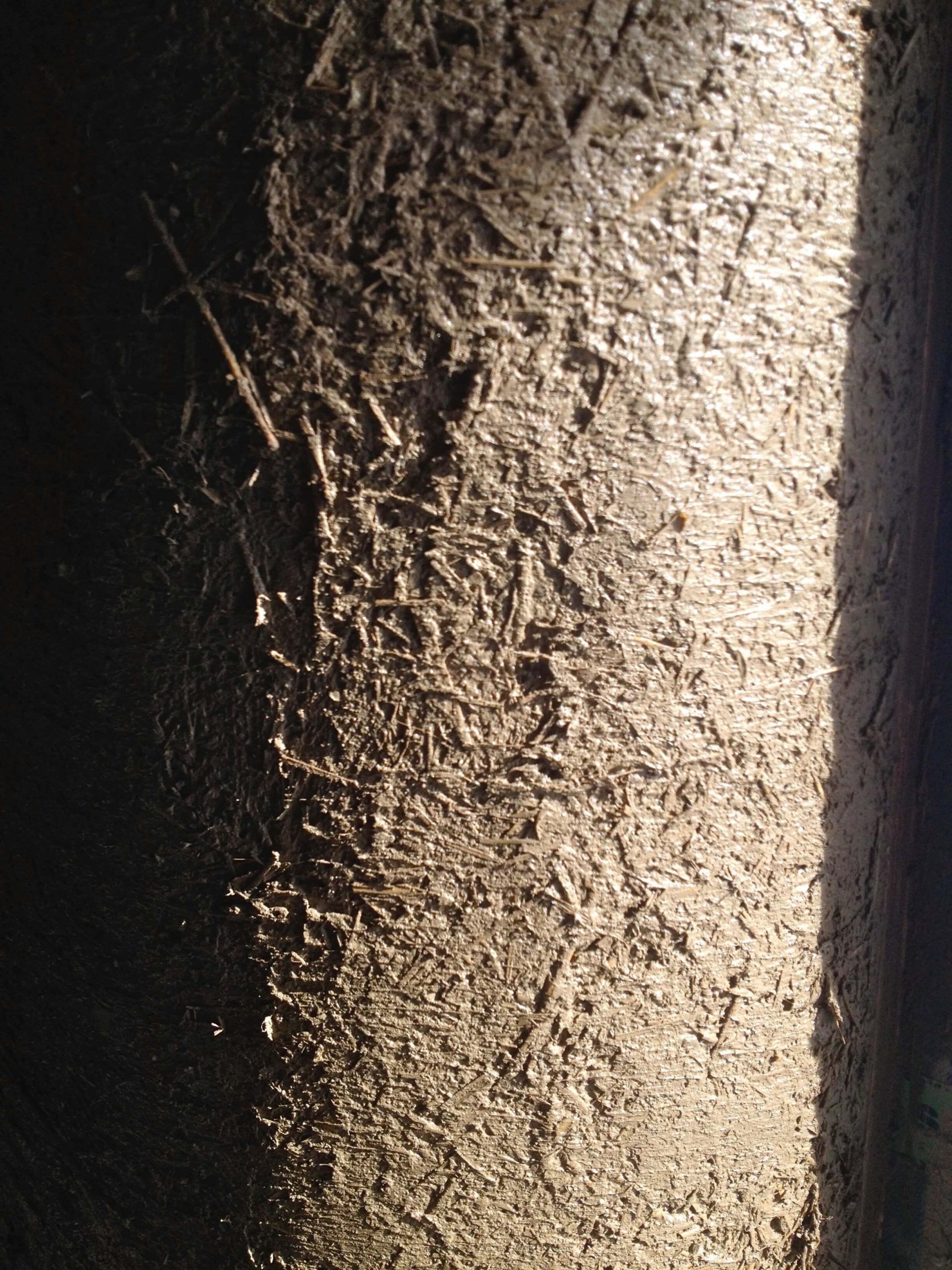
Once the bales are installed, we use a “two-part, one-coat” clay plastering system. A thin coat of a wet clay plaster (1 part clay to 3 parts sand) is rubbed into the surface of the bales to provide a strong key into the straw and an adhesion layer for the bulk coat that follows immediately. This adhesion coat goes on very quickly. The bulk coat is a mix of clay, sand and chopped straw (1 part clay, 1.5 parts sand, 3 parts chopped straw). The more clay plastering we do, the more chopped straw we’ve added to our plasters. The bulk coat resembles a mix between cob and light-clay straw. This coat has enough tensile strength from the chopped straw to be applied to the wall at almost any thickness, from as thin as 1/2 inch to as much as 3 or 4 inches. This allows us to make a straight wall out of a lumpy, bumpy bale wall in a single coat.

We find that this type of clay plastering is a great deal more beginner-friendly than lime or cement based plasters. The clay plaster can be applied by hand, and no trowels or tools are required to make a very straight, even and beautiful wall. To achieve the same results with other plasters would take several more coats and a lot of troweling practice.

This part of the work is also very social, very engaging and a lot of fun. Building a house while up to one’s elbows in mud is a real joy. The fact that we are making an airtight, highly insulated and long-lasting wall system only matters after we wash our hands and look back at the beautiful walls!

Clay Plasters: Beautiful and Green

In advance of Endeavour’s upcoming Make Your Own Clay Finish Plasters workshop on November 26 & 27, we thought we’d direct your attention to an article that Chris wrote recently for Our Green Home magazine.

There is still room in this workshop… contact us to register and you too can be making beautiful, healthy walls!

Natural red pigment and untinted clay walls

Clay Plasters: Beautiful and Green

Imagine the walls of your home giving you a warm, gentle hug every time you are in a room. That’s the way most homeowners describe the effect of clay plasters as a wall finish. Clay plasters are also among the very greenest finishing materials available, making them an attractive option for remodeling an existing room or for new construction.

The use of decorative clay plasters is as old a practice as home building itself. The insides of caves, grass huts and early stone buildings around the world were finished with coloured clay plasters. Largely ignored in North America for the past couple of centuries, the use of clay plasters is enjoying a remarkable resurgence as homeowners seek natural, healthy and affordable ways to enrich their homes.

The basic ingredients in a clay finish plaster are no different today than they were thousands of years ago: clay, sand, pigment and a glue-like binder (often based on cooked flour!). What has changed is the method of application. In the past, many clay plasters were applied by hand to rough, uneven walls. Now they are applied with trowels onto straight, flat wall surfaces. But the link to the past is obvious when you experience a modern clay plaster as the richness and depth of colour and the unique interaction with light and sound are unparalleled by any modern materials.

For those concerned with indoor air quality, a clay plaster is a great choice. They are completely non-toxic and do not off-gas in the wet or dry state. They involve no petroleum products or other chemicals in their manufacture or application, and have been shown in German research to have some effectiveness at absorbing and transforming pollutants in the household air. The same research shows them to have excellent moisture-handling properties, helping to regulate humidity in the home.

Clay plasters can be applied directly over most existing wall surfaces and finishes, including latex and oil paints, drywall and paneling. On painted surfaces, a mixture of natural glue and sand is rolled onto the wall to provide the plaster with “tooth,” a rough surface that allows the plaster to grip the wall. The plaster can be recoated in the future, or can be painted over with conventional or clay-based paints.

The application of clay plasters takes some practice, but it is well within the ability of most homeowners to apply. Some practice on a spare sheet of drywall will help to hone a technique, or you can take lessons in application from professional plasterers. The plasters can be applied with an endless variation of appearances, from perfectly smooth to roughly troweled or textured finishes. The plasters can be burnished so they shine or left with matt surfaces. The possibilities are almost endless. A wide range of natural pigments allows a vast range of colours to be achieved, and the colours tend to be warmer and “friendlier” than synthetics.

Orange pigment in a natural plaster

There are some manufactured clay plasters available on the market, and these products have been largely responsible for the surge of popularity for this type of finish. It is also straightforward to make your own clay finish plasters from locally available ingredients with the help of some research and instruction on creating mixes. Buyers should be wary of products marketed as clay plasters that feature some amount of clay in a petroleum-based paint.

Clay plastered walls invite amazed reactions and a desire to touch the wall from those experiencing them for the first time. Unique, beautiful, healthy and affordable; there is nothing that quite compares to a clay plastered wall.


Tadelakt Workshop Wrap-Up

Our first workshop at Endeavour, Tadelakt and Advanced Lime Plastering, was a great success!

Tadelakt is a historical means of applying and treating lime plasters to make them waterproof. Originating in Morocco, the plasters are applied in successive thin layers, troweled smooth and then burnished with hard stones using an olive oil soap. The soap and the lime have a chemical reaction that creates the waterproofing. The soap and stone burnishing also creates a beautiful, glassy finish that is amazing to see and touch!

Over five days, instructor Ryan Chivers taught our group of intrepid plasterers a remarkable amount about lime and lime plastering. Here’s a quick look at what we covered in the workshop…

A Tadelakt Workshop Gallery
A Bit About Lime

The process of actually mixing the plaster is the same that we’ve experienced with clay and lime cement plasters. One of the best things Ryan taught us was that the need to “slake” lime into a putty is really not necessary with modern, Type S lime. Modern, north american limes are processed in such a way that they are fully hydrated at the manufacturer using heat and pressure. This greatly simplifies the process of working with lime plasters of all types as the weeks or months of slaking in water are eliminated. However, the plasters do want to be mixed at least a few hours before use as the lime does take some time to fully take up the water that’s been added. We mixed a day ahead of ourselves throughout the workshop.

 Applying Lime Plaster

Our first plastering was not tadelakt, but a finish lime plaster that was applied directly over painted drywall. The walls were prepared by painting on a mix of white glue and sand, which gave adhesion for the plaster. We then applied two very thin coats of lime. This system was very quick (a 12×15 room took about 1 hour for 2 people to apply, per coat). We’ll post finished pictures of the room once it’s all cured.

Practicing Tadelakt

Tadelakt is all about timing! You could read about doing tadelakt forever, but it’s all about timing, feel and doing the right thing at the right time. Luckily, Ryan was great at preparing us for what to expect at each stage. By practicing first on our tiles and cob balls, everybody began to understand the stages of tadelakt and how to know when it was time to move on.

Applying Tadelakt

We did one tadelakt wall in a “dry” area of the house. To be fully waterproof, the tadelakt must be done just right, so we had one wall that will not be exposed to direct water on which to practice. And it’s a good thing… it really does take a lot of practice (much more than one wall!) to get a feel for the technique.

Tadelakt Shower/Bathroom

Tadelakt is beautiful anywhere, but in bathrooms, showers and other wet areas it mixes beauty and functionality like no other natural material.

The timing for tadelakt gets more complex the more surface area there is to cover. In this bathroom, we had several different substrates under the tadelakt which all affected the timing, and we had many people applying, troweling, stoning and soaping. The result, however, is a wonderful, rich, shiny plaster!

In the end, the crew did an amazing job. We’ve all been promised a nice hot shower in the finished bathroom to appreciate our work!

We’ll post photos of the finished bathroom when it’s ready. The tadelakt takes 28 days to fully cure…

Our thanks to Ryan for teaching a terrific workshop and to all the participants for so much fun, hard work and learning together!


Making and Applying Your Own Clay Finish Plasters

November 26-27, 2011 

Instructors: Jen Feigin, Chris Magwood
Endeavour Centre
Peterborough, Ontario
 www.chrismagwood.ca 

Workshop Description

Clay finish plasters bring the beauty and benefits of natural building to any home, affordably and approachably.

These homemade plasters can be applied on any typical wall surface, including drywall (painted or new) and plasters or masonry of all kinds. The plasters are made from easily obtainable, affordable natural materials and can be mixed and applied at home in a vast range of colours and textures.

Clay plasters add a dimension to a room unobtainable with any other finish. In addition to their inherent beauty, they are completely non-toxic and can help regulate humidity in a room. They are durable and repairable and the best way to make your home a more natural, warmer and healthier place.

In this workshop, you will learn how to source the required materials, prepare wall surfaces for clay plastering, mix and tint plasters and apply to wall surfaces. During the workshop, you will create a series of sample boards in the colours of your choice to take home to help make plaster choices for your own home/project.

Entry Requirements

Open to beginners and experienced plasterers

Fee

$250

Maximum class size: 12