Tag Archives: natural building

Open House for Canada’s Greenest Home

Join us on Saturday, March 9, 10am – 4pm!

Canada's Greenest Home nears completion

Canada’s Greenest Home nears completion


We have attempted to build the most sustainable home possible, and want to share the results with you! Since April, 2012, the students and faculty of The Endeavour Centre have been working on creating a home that showcases the best in sustainable new construction, and we’re excited to open the doors and show you what we’ve created. Come and see a wide range of sustainable materials and systems, including straw bale walls, clay plasters, Durisol foundation, triple glazed windows, composting toilets, rainwater harvesting and treatment, air source heat pump, ERV, comprehensive energy monitoring, solar hot water, non-toxic finishes and much, much more
Progress Gallery
We hope you’ll come and take a tour at 136 1/2 James Street, Peterborough, Ontario
You can follow the progress of the entire project on our blog

Seasoned Spoon Earthbag Root Cellar Almost Finished

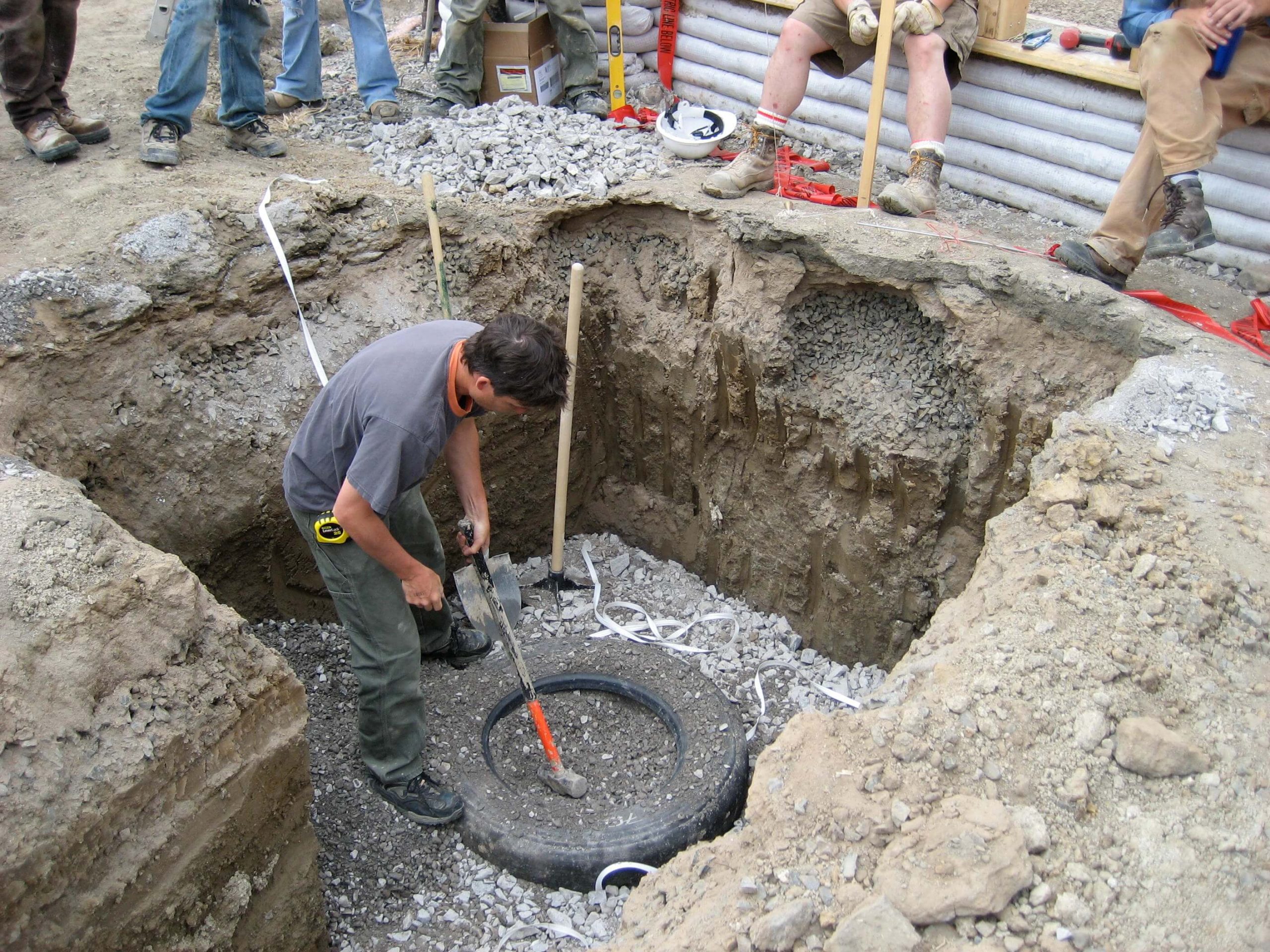
More Trent University students may be able to eat locally-grown produce year-round at The Seasoned Spoon cafe, now that their subterranean earthbag root cellar is nearly complete.

This project is very unique, using local low-impact materials to create a food storage structure that will be able to house a range of vegetables at proper temperature and humidity levels year round, without energy intensive cooling or heating equipment.

Here is a complete set of progress photos, showing the building from start to finish:

Endeavour would like to thank the Seasoned Spoon for the chance to be involved with such a great project. Thanks also to Trent University for accommodating the build.

Tim Krahn of Building Alternatives was the adventurous and participatory structural engineer on the project, and Ben Parkes was the lead builder, with lots of help from Justin McKeiver and lots of volunteers.

We’ll post a final look at the root cellar when it’s all complete.

Designing Your Own Sustainable Home: A Workshop for Owner-Builders

March 2-3, 2013

Workshop Instructor(s): Chris Magwood
Endeavour Centre
Peterborough, Ontario

Workshop Description

The dream of designing and building one’s own home is one of the most deeply held desires in our culture. The dream of designing and building a sustainable home marries that desire with a wish to live lightly (and affordably!) on the planet.

However, many questions face the prospective owner-builder setting out on this journey. To design yourself or hire a designer? To build yourself, or hire builders for different phases? How to choose from a myriad of competing natural building materials? How to choose heating options, water and waste options, electricity options? How to manage budgets and timelines? How to choose a piece of land? This workshop will explore all of these questions in an in-depth way.

The workshop is designed to be an un-biased look at all the options available to the prospective owner-builder, and to assist you with tools to help you assess and choose your way to the house of your dreams. You will leave this workshop ready to handle all the competing claims and information you will face by focusing on your personal goals and aspirations and creating a road map for how best to meet them.

Entry Requirements

Open to all

Fee

$325

Maximum class size: 12

Designing Your Own Sustainable Home: A Workshop for Owner-Builders

October 13-14, 2012 – Workshop full

Workshop Instructor(s): Chris Magwood
Endeavour Centre
Peterborough, Ontario

Workshop Description

The Design Your Own Home workshop class celebrates two productive days!

The dream of designing and building one’s own home is one of the most deeply held desires in our culture. The dream of designing and building a sustainable home marries that desire with a wish to live lightly (and affordably!) on the planet.

However, many questions face the prospective owner-builder setting out on this journey. To design yourself or hire a designer? To build yourself, or hire builders for different phases? How to choose from a myriad of competing natural building materials? How to choose heating options, water and waste options, electricity options? How to manage budgets and timelines? How to choose a piece of land? This workshop will explore all of these questions in an in-depth way.

The workshop is designed to be an un-biased look at all the options available to the prospective owner-builder, and to assist you with tools to help you assess and choose your way to the house of your dreams. You will leave this workshop ready to handle all the competing claims and information you will face by focusing on your personal goals and aspirations and creating a road map for how best to meet them.

Entry Requirements

Open to all

Fee

$350

Maximum class size: 12


Engineering Outside the Box

Please note:
Bruce King is giving two talks in Toronto. For the public presentation, Architecture After Oil, read more here.

For information on the professional seminar, Engineering Outside the Box, continue reading this page…

Engineering Outside the Box, Friday July 27th

Endeavour is pleased and excited to present a seminar with two of the most influential engineers in the realm of natural and sustainable building… Bruce King and John Straube.

The three-part seminar covers everything a building design professional would want to know about working with traditional and emerging natural building materials. The seminar is eligible for OAA credits.

Don’t miss this opportunity to learn from two of the leading figures in natural building!

You can register here.

You can download the seminar outlines here.

ARIDO & OSBBC members receive 40$ off.
Please contact your organization for more info about discounts.

For student rates please contact Endeavour at 705-868-5328 or email us.

Prefab Bale Walls on Second Floor

In a repeat performance of crane work and team work, the Endeavour crew installed the prefabricated straw bale wall panels on the second story of the home.

Once the panels and framed window openings are linked and plumbed, we’ll be ready for the roof trusses and the site built straw bale walls.

The team is taking a break for a few days, so posts will resume again next week…

Prefab Wall Panels Installed

Upward progress on Canada’s Greenest Home was marked by the arrival this week of our prefabricated straw bale wall panels from NatureBuilt Walls. The class had previously traveled to the NatureBuilt facility to assist in the construction of the panels, and it was great to see them arrive!

The 24 panels for the two stories of the home arrive on one truck


We hired a crane to lift the panels from the delivery truck and onto the foundation. The site of the home this year offered some challenges… between low power lines at the front edge of the property and a long, skinny lot and home design, the usual boom truck used to move the panels was unable to do the lift. So it was Peterborough Crane to the rescue!

The crane sets up and awaits the arrival of the prefab wall panels


The placement of the walls went very quickly and smoothly, and showed why this form of straw bale building is so attractive. Within a couple of hours, we had a full compliment of pre-plastered straw bale walls standing on our foundation. There is no other form of sustainable building that brings such a combination of ease and speed of installation with such a simple, naturally- and locally-based form of construction. We will also be building our north wall in the “conventional” site-built manner, which will offer the class a great comparison of the two methods.

A prefab bale wall panel is lifted into place on the foundation

Soon, the second floor will be ready to receive the next round of prefab walls…

Prefabricated Straw Bale Walls for Canada’s Greenest Home

This week the Endeavour class spent a day at the facilities of NatureBuilt Wall Systems, where we assisted with the construction of some of the Bio-SIP walls that will be used in Canada’s Greenest Home.

The Bio-SIPs are largely identical to the load-bearing straw bale walls that have been used since the first straw bale buildings were constructed in the late 1800s. But rather than building them by stacking bales vertically and plastering in several coats, they are built in a shop space and plastered while lying horizontally. This greatly reduces the amount of labour time involved and ensures walls of consistent strength and size.

We have chosen to use the Bio-SIPs because they meet so many of the criteria we have for Canada’s Greenest Home:

  • Locally harvested materials
  • Renewable materials
  • Reproducible technology
  • High energy efficiency
  • Low embodied energy
  • No off gassing or toxins
  • Affordable

Many straw bale buildings use an extensive wooden framework to create a structure to support a roof so the straw bale and plastering work can be done under protection from weather. The Bio-SIPs use the simplicity and low lumber count of load-bearing walls without the need for excessive wooden framing, capturing the benefits of the load-bearing capacity of straw bale walls.


NatureBuilt takes environmental responsibility seriously, right down to the use of used fryer oil as a release agent in their forms. It was great to be in a workplace where our ethics at Endeavour are so closely matched.

The class got to experience the entire construction process for the panels, including assembling and leveling the wooden frames, selecting and sizing bales, mixing and placing plaster and assembling the bales in the frames. In one short working day, we were able to help build nine of the 24 panels for our project.

The walls will be delivered to our construction site when the first floor framing is ready to receive them.

Our thanks to Ian Weir of NatureBuilt Wall Systems for giving us the opportunity to be part of the production of the Bio-SIPs!

A Finished Durisol block foundation

The Endeavour class has completed the foundation for Canada’s Greenest Home. The crawlspace foundation is made with Durisol blocks. Durisol is an insulated concrete form (ICF) that uses waste wood chips in a cement slurry to form large blocks (in this case, 14 inches wide by 12 inches high by 24 inches long) with an integral Roxul insulation insert. These blocks create a wall with an R-28 insulation value.


The blocks are dry stacked in running bond, and are easily cut with a regular circular saw and blade where required. A grid of rebar is placed in the blocks both horizontally and vertically, and the open channels inside the blocks are poured with concrete (in our case, with the highest slag content possible).

The Durisol system uses waste wood chips, slag content in the cement binder and the Roxul insulation is made with recycled steel slag to create the mineral wool insulation. It’s a higher impact foundation than we would typically use, but because we’re providing a conditioned crawlspace for this building, it was the best solution for this application.

Welcome to Endeavour!

We are very excited to be introducing the Endeavour Centre, a new not-for-profit sustainable learning, building and living centre! While it represents a new beginning in many ways, it’s also the culmination of everything its founding members have been doing as builders and teachers over the past number of years.

We envision Endeavour as an exciting addition to the existing “hubs” of sustainable building activity that dot the globe and provide education, inspiration and support to sustainable builders worldwide. “Hubs” like this don’t spring out of nowhere. Our past roles as creators and instructors at Fleming College’s sustainable building programs has put us at the centre of a growing network of builders, teachers and graduates. With the Endeavour Centre, we hope to intentionally foster this community and help it to grow and develop into something exciting and dynamic.

The heart of Endeavour is its programs. Our full-time New Construction and Renovation programs will offer students an in-depth, hands-on experience in a real-life building project from start to finish. We will be adding a full-time Sustainable Design program to that roster of in-depth, intensive, hands-on learning opportunities.

We’ll be rounding out our full-time offerings with a wide range of exciting workshops that will bring together talented practitioners of sustainable and natural building techniques to share their knowledge in shorter formats. Our workshops will maintain the focus on hands-on, practical learning.

In a world that often seems overfull with “doom and gloom,” we have found that hands-on sustainable building skills are a sure way to overcome malaise and empower people to actively participate in building better communities. The “hub” we envision at Endeavour will bring together people who share a passion for sustainable building and create ties that enable and inspire real change.

We sincerely hope you’ll join us in this Endeavour!

Sincerely,


Chris Magwood, Jen Feigin and Diane Csenar

Founding Directors,

The Endeavour Centre