Tag Archives: energy efficiency

Open House for Canada’s Greenest Home

Join us on Saturday, March 9, 10am – 4pm!

Canada's Greenest Home nears completion

Canada’s Greenest Home nears completion


We have attempted to build the most sustainable home possible, and want to share the results with you! Since April, 2012, the students and faculty of The Endeavour Centre have been working on creating a home that showcases the best in sustainable new construction, and we’re excited to open the doors and show you what we’ve created. Come and see a wide range of sustainable materials and systems, including straw bale walls, clay plasters, Durisol foundation, triple glazed windows, composting toilets, rainwater harvesting and treatment, air source heat pump, ERV, comprehensive energy monitoring, solar hot water, non-toxic finishes and much, much more
Progress Gallery
We hope you’ll come and take a tour at 136 1/2 James Street, Peterborough, Ontario
You can follow the progress of the entire project on our blog

“Breaking” the Air (tightness) Barrier

At 0.99 ACH50, we broke the magical (in our minds!) 1.0 barrier. This is a very air tight home!

After our somewhat disappointing blower door test last week, we threw some mud at the walls (well, we placed it carefully around the edges of the wall), did some taping and caulking, and then had Ross and Kat Elliott of HomeSol Building Solutions come by to do our official blower door test.

We went from a code-compliant 3.1 ACH50 (air changes per hour at 50 Pascals) to an almost PassiveHaus compliant 0.99 ACH50! We could feel some small areas of leakage to be addressed (almost all were failures of the Tuck Tape to properly adhere and seal against the air barrier membrane!). After the test, we realized that we hadn’t covered over the sump pit in the basement, and so we think we can do even better on the final test once the house is finished. Ross suggested that it’s common to improve the air tightness by around 20% once all the interior wall and ceiling sheathings are in place.

Even if we end up slightly shy of the 0.6 mark, we are very excited to have built a house that far surpasses the air tightness of conventional building, and to have done that using mostly straw bale walls and even clay plasters. It’s an indication that the use of natural building materials and “alternative” methods can be part of an extremely tight and energy efficient building.

Our thanks to all the students whose constant awareness and vigilance regarding air tightness as we built the house helped to ensure that this result was possible. Way to go, Graham Wise! And our thanks to Matt Caruana for last week’s test… we wouldn’t have achieved this score without a first kick at the can!

Blower Door Test #1

As those of you who’ve been reading this blog will know, we’ve worked hard to make Canada’s Greenest Home as air tight as possible. In fact, we’re aiming to try and achieve a PassiveHaus approved 0.6 ac/h (air changes per hour at 50 Pa depressurization). So it was exciting today to have Matt Caruana come by and bring his blower door outfit and his laptop to give the house a first trial run! This is in advance of having Ross Elliot from HomeSol Building Solutions, our official energy rater, come by next week.

Matt Caruana calibrates the blower door and reads the results on his laptop. The blower depressurizes the house, so that outside air tries hard to find its way in. On a cold day like this one, it’s easy to feel the air coming in.

And it’s a good thing we had a first-round test with Matt!…

The first test showed that, despite all our efforts, there were some significant areas of leakage. Fortunately, they are all areas that can be addressed before the next test.

Our result for the first test was 3.15 ACH50, with an equivalent leakage area of 74 square inches (about an 8×9 inch hole in total over the 3,780 square feet of wall area, or 1/7355 of the wall area). What happened? Where were the leaks?

The good news is that we did a really good job of sealing the common areas of leakage. We detected barely any leakage from any of the windows, electrical boxes or seams between foundation and floor or between the two upper floors. All our efforts to make these areas tight definitely paid off.

There was some leakage from our temporarily taped up attic hatch and the cover over the temporary back door. These can be better taped next time around and that will definitely make a noticeable difference in the results.

By far the leakiest area was around the edges of our site-baled north wall. Despite using air fins at all the seams with the prefab walls and the ceiling, the upstairs north wall was leaking significantly all the way around where the plaster had shrunk away from the edges. A quick calculation of this 1/8″-1/4″ gap all the way around the whole north wall says that this could account for almost all the leakage area Matt detected.

This seam leaked like crazy! The air fin that extends behind the plaster was not sufficient to keep air out.

This seam used the exact same style of air fin and in this case no air came through. So our system works, but not reliably!

Surprisingly, the downstairs north wall, which is built in the same manner, using the same detailing, had barely any detectable leakage. Visually, the separation of the plaster is the same thickness, and we used the same plaster mix and plasterers, and the air fins were made in the same way. Our best guess is that the mesh over the air fin may have been better embedded in the plaster downstairs, keeping the plaster tighter to the wall. The takeaway lesson for us is that while this detail can work, it’s definitely not a guaranteed way to seal this seam.

Similarly, there were leaks along the edges of a few of the prefab straw bale wall panels. They were detailed in a similar way to the site baled walls, with an air fin under mesh around the edges of the plaster. And again, some worked very well and others did not. We’ll have to do more thinking about how to make this a more effective and reliable detail on future builds.

As with the site baled walls, a few seams in the prefab walls leaked around the air fins.

The majority of the seams in the prefab bale walls did not leak. But there was no visual indication to say which worked and which didn’t.

Fortunately, these leaky areas can be easily addressed by caulking the gaps between the edge of the plaster and the abutting wall. There is still another layer of finish plaster to go on the walls as well, which will further help to seal and protect the caulking. We’ll take care of these areas before the next blower door test, and then be able to focus in on finding the smaller holes!

A result that sees the house achieve a result somewhere between the 1.5 ACH50 of the R2000 program and the 0.6 of PassiveHaus would make us really happy!

Our results today point to the difficulties involved in making buildings as air tight as possible. We had drawn careful details at the planning stage and spent a lot of time and energy on site making sure those details were well executed, and still didn’t get a great first result. Because we’re taking the time to test at multiple stages, we will find these leaks and fix them. But not every house will get this attention to detail, without which air tightness is a nice idea but unlikely to become a reality. Each and every member of the build team needs to have air tightness in mind as they do their work, and builders need to plan for the time it takes to test and address issues. It would help if such blower door tests were mandatory!


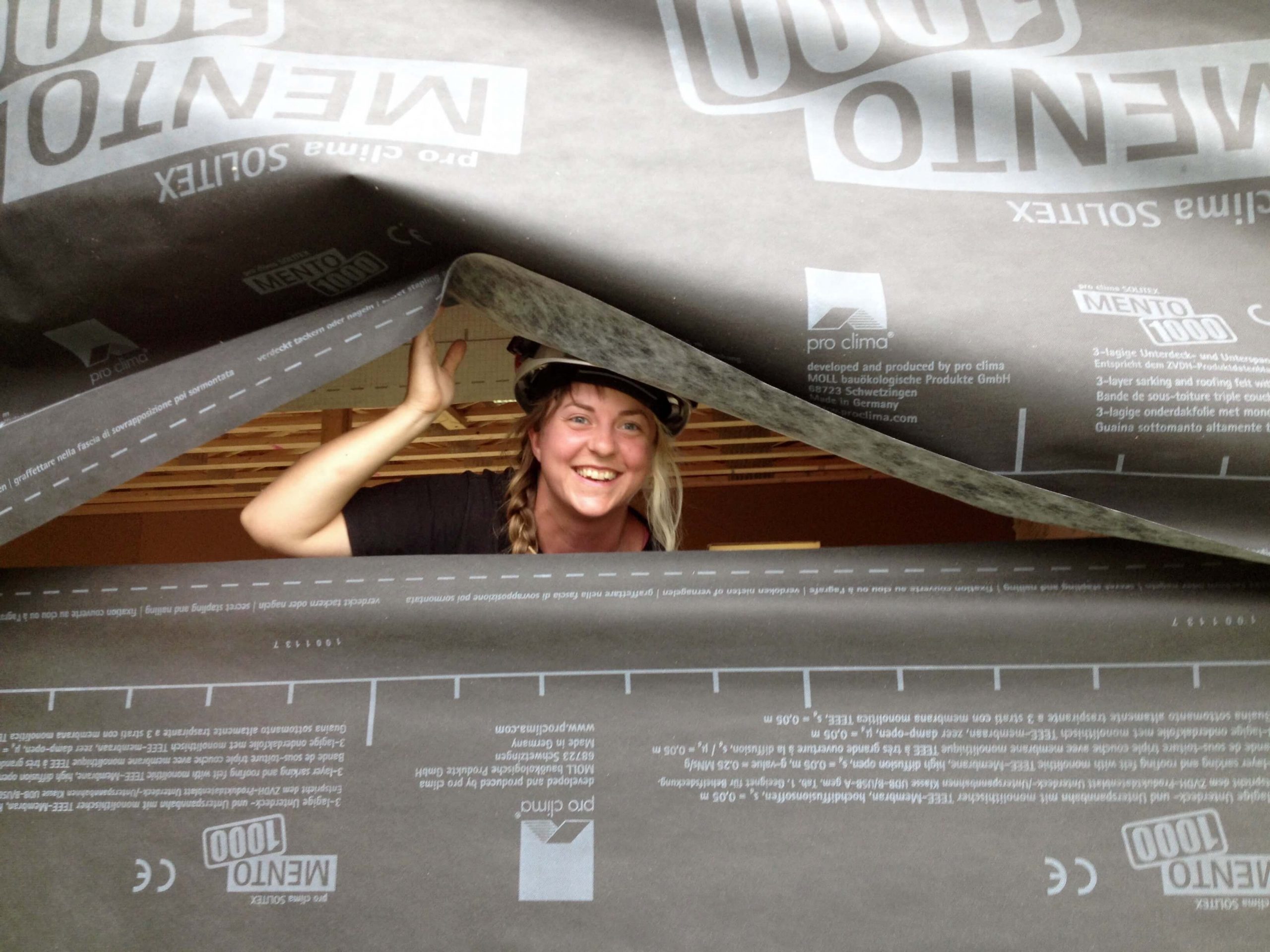
Siga Tapes Make Things Airtight

As those who have followed the progress of Canada’s Greenest Home will know, we are taking the air tightness of this house very seriously. A great deal of thought has gone into ensuring construction details that make it easy to make an air tight enclosure, and just as much effort has gone into work on site to be sure we follow through on those details (much thanks to Graham Wise and our other diligent folders and tapers!).

Siga’s Wigluv tape makes a great seal between the window unit and the air control membrane.

As much as possible, we try to have the air tightness details addressed by building in a way that minimizes breaks in the air control layers and penetrations through these layers. However, there are places where joints and penetrations are impossible to prevent. To date, we’ve done our best to caulk and tape such areas with the best materials available to us.

That pallet of available materials just improved dramatically with our introduction to the line of tapes and membrane materials from Siga. These Swiss products are now imported into Canada by Herrmann’s Timber Frames in Curran, Ontario. As soon as we opened our first roll and began to apply it, we knew that air sealing for us was changed forever!

Siga’s Rissan tape seals the membrane to the electrical box hood.

We are working largely with two products from Siga. The first is their exterior-grade tape, called Wigluv. This tape is outrageously sticky, and the tape material very flexible. We are using the Wigluv to tape our air control layer (a conventional Canadian housewrap) to our windows to provide a seal at this important junction.

The Wigluv takes some learning to apply cleanly, as it is so sticky that any errors in application result in tape stuck to fingers and any other surface that gets in the way! However, we quickly figured out how to fold the tape against the window to provide an excellent seal. Working from bottom to top of the window, we provide positive overlap at each tape seam. The flexibility of the tape means that the odd lump or bump in the application folds down completely, and if the corner is not perfectly ninety degrees, it will bend out of the way of the strapping we put on next. I feel like these will definitely be the most air tight windows we’ve ever installed.

The second product is similar, but meant for indoor applications, and is called Rissan. This tape is flexible enough to be very useful for sealing round holes in membranes, such as plumbing vent stacks and electrical conduits. Equally sticky as the Wigluv, the Rissan bonds to pipes, wires and conduits firmly and provide a great solution to these very hard-to-seal areas of the home. We will use the tape from both sides of the barrier wherever possible to further ensure a tight seal.

Whether or not these tapes have long-term lasting adhesion remains to be seen, but their test results are impressive and they far surpass anything that is widely available in the North American market.

This entire window is now very well sealed and insulated.

For the time being, it’s too bad we have to import these tapes from Europe. Canada used to be a leader in the first wave of air tightness products for homes, but until somebody in North America starts making tapes of this quality, we’ll be using these Siga products to ensure our seams and joints are as air tight as possible.

Air Source Heat Pump

Among the many challenges involved in meeting the Living Building Challenge standard for Canada’s Greenest Home, one of the biggest was how to heat the home given that the LBC does not accept combustion devices of any kind for any purpose.

The Mitsubishi Zuba heat pump is installed on the exterior of the house.

The heat exchanger and plenum for the interior side of the Zuba.

Our first choice for heating this home was going to be a pellet boiler. Impressed with the efficiency and cost of these systems, we were also aware that a number of local pellet making facilities (including one less than 1km away from the home) meant that our fuel supply could be reliable and entirely based on existing waste biomass in the region.

Once we understood that this combustion option was not feasible (and I’m not sure I agree with the LBC’s reasoning on this point), our focus turned to heat pumps, both ground source and air source. Heat pump technology is a great option, as it is the only heating (and cooling) technology that is more than 100% efficient. With combustion devices, for every unit of fuel input there is slightly less than one unit of heat output (hence the ratings that might state efficiencies in the 90% range). With heat pumps, each unit of energy input (electrical energy, used to drive the pump) there is between 1.5 and 5 units of heat created, meaning that efficiencies can be stated in the 150-500% range.

A heat pump works by circulating a refrigerant with a boiling point that is designed to be in the temperature range expected on the outside of the building. By compressing this gas and forcing it into a gaseous state and then allowing it to return to a liquid state, the refrigerant goes through two phase changes. The heat that is transferred during these phase changes is significant, even though the temperature of the refrigerant is not.

The heat pump cycle explained. The important part to know is that the phase change of the refrigerant releases usable heat, even if the actual temperature of the refrigerant is not “hot”. Image from CMHC

This isn’t magic, and it isn’t even a new technology. Your refrigerator is a heat pump, as is your air conditioner. The premise has been around for decades, but has only recently been applied to heating homes on a large scale in the past decade. The use of heat pumps in cold climates has not been feasible until quite recently, when Mitsubishi introduced their Zuba range of cold climate heat pumps. These units are able to make usable heat at temperatures as low as -30C, making them feasible as the sole heat source for a northern climate home as long as the home is made to be energy efficient.

The heat loss calculation for Canada’s Greenest Home was 22,524 Btuh (British Thermal Units per hour). The Zuba is capable of producing 34,130 Btuh, so it is well within the unit’s capacity to fully heat this home.

As with all heat pumps, the Zuba can run in reverse and be an efficient air conditioning unit in the summertime.

The Zuba has two components. On the exterior of the house there is the heat pump unit. On the interior of the house there is the heat exchanger and the air plenum plus the fan and switchwork for the system. It is connected to conventional ductwork to supply heated air to the whole house.

The Mitsubishi Zuba units are supplied in Ontario by Mitsair. Our system was installed by Crown Heating in Peterborough. Our thanks to both companies for their professional assistance.

The decision to go with an air source heat pump was made largely based on the cost of installation. While a ground source unit offers better efficiencies (especially at colder outdoor temperatures), the cost of installation is quite a bit higher, and the payback on the additional investment is well over a decade. Given our investment in other technologies for this home, we decided in this case that the lower cost of installation and the very good efficiencies for the unit made it the right decision for Canada’s Greenest Home.


“Smart” Vapour Barriers?

One of the most important – but least glamorous – of the features of Canada’s Greenest Home (and most natural and sustainable buildings) is the vapour permeability of the walls. It doesn’t sound like a big deal, but it’s a major difference between conventional building and so-called alternative building and represents a very different way of thinking about building performance that can have important performance ramifications. What follows is a simplified explanation of this difference. For more detailed information, I suggest the excellent material available for free at BuildingScience.com.

The “moisture balance” is the key to healthy walls… making sure that incoming moisture is able to leave the wall at a rate that avoids build-up and damage.

To understand the difference, one must first know that moisture will always move from areas of high concentration to areas of low concentration (a variation of the “nature abhors a vacuum” principle). For the majority of the heating season, this means that moisture is trying to move from our warm, moist interior spaces into the outdoors, where it is cooler and drier. If there are leaks or holes in the building enclosure, this warm moist air will move quickly. But even if there are no leaks or holes, this moisture will still migrate to the exterior by diffusion – a molecular movement of moisture through the materials of the building. A material’s ability to resist this diffusion is known as its permeability. Materials with low permeability ratings allow very little moisture through, and materials with high perm ratings can allow quite a bit of moisture through.

Okay, that’s a lot of words to say that there is a natural vapour drive through the enclosure of a building.

For the past few decades, mainstream buildings in northern climates have relied on a vapour barrier – basically a thick plastic sheeting – to prevent air leaks from inside to outside and to prevent the diffusion of moisture into the wall. This practice arose from the failures of many early “air tight” homes, in which moisture was able to accumulate in the wall cavities and resulted in rot and mold issues. The solution was to use a vapour barrier membrane on the interior of the walls to prevent this from happening.

In the natural/sustainable building world, we have always preferred to use wall assemblies that are vapour permeable. This acknowledges the fact that the vapour drive in buildings is inevitable, relentless, and not necessarily a problem unless materials are introduced that do not allow for this vapour to pass through at a reasonable rate. A good example of such a material is OSB (chip board) or plywood, the two most common exterior sheathing materials in conventional construction. These materials will resist the migration of moisture such that it can accumulate and condense on the interior side of the sheathing and begin to cause problems. If moisture can’t pass through the exterior sheathing, it must be prevented from entering from the interior side… hence the plastic vapour barrier.

The plastered straw bale walls (both the lime-cement prefab walls and the clay-plastered site-baled walls) are examples of permeable walls. The plasters on the interior and exterior as well as the straw insulation are very capable of allowing the movement of moisture through the materials in either direction. In this way, problems arising from moisture accumulation are prevented, and the walls have an ability to dry out in either direction should there be times of high moisture loading.

Canada’s Greenest Home also incorporates some double stud frame wall sections, including the entire south wall and the window openings in the prefab bale walls. Since we are not using plasters on these walls (we could have… but wanted to demonstrate some more sustainable, conventional approaches), a sheet barrier of some kind is required. We definitely didn’t want to give up on a vapour permeable strategy…

The south frame walls are sheathed in DensGlass for its high vapour permeability.

Ethical sourcing is part of the decision making process, so union-made materials from regional suppliers are favoured.

Our first step was to choose an exterior sheathing that is quite permeable. For this we used DensGlass, a gypsum board product (union made in Ontario, Canada and fully recycleable) with a high perm rating. Should we have moisture movement through these walls, it will be able to dry through the DensGlass at a rate similar to our plastered walls.

The second step was to find a sheet barrier that meets the current code requirements for a vapour barrier (BuildingScience.com argues for the term “vapour control layer” which is a much more accurate term for what’s required) and yet doesn’t completely blow our desire for vapour permeability.

The “smart” barrier we chose is MemBrain.

The answer seems to have come in the form of a “smart” vapour barrier, as suggested by Ross Elliott at HomeSol Building Solutions (our excellent energy auditor/advisor). In our case, we used a product called “Membrain” (insert groan here) from CertainTeed. This product (and similar versions from other companies) offers the vapour resistance of conventional plastic sheeting, but with a composition that allows for drying back through the membrane should conditions on the backside be more humid. While it lacks the low embodied energy and friendliness of the plasters we used elsewhere, these products allow conventional builders to achieve some of the same benefits at a very low cost and without having to switch building techniques.

An interior wall with the MemBrain barrier applied over the dense packed cellulose insulation.

You can read more about these “smart” barriers and how they work at BuildingGreen.com.

While we would always make plasters and natural insulations our first choice, the combination of recycled drywall, smart membrane, dense-packed cellulose insulation and permeable sheathing is a way to embrace “permeable” thinking within a mainstream paradigm.

Canada’s Greenest Home is an attempt to blend more “radical” natural building strategies with those that can work for mainstream builders. We’d like to see houses like this one be replicated by conventional builders, as well as natural builders. While builders at each end of this spectrum may choose one strategy/material over another, we think there is value in both approaches and are trying to demonstrate both in this project.

Triple pane windows installed

Choosing high quality windows is a very important part of our strategy to make Canada’s Greenest Home as energy efficient as possible. There is a lot to consider when making a window purchase… here is how we went about making our decision to buy Inline windows.

The triple pane, fibreglass windows from Inline have excellent thermal properties, are good looking and well made.

First thing to consider is the material that the frame of the window is made from. Choices include wood, vinyl, aluminum and fibreglass. We chose fibreglass frames for several reasons. They are long lasting, don’t expand and contract as much as other materials, don’t offgas and have good thermal resistance. Vinyl windows weren’t even a consideration, as the PVC is a red-list material for the Living Building Challenge. The offgassing of vinyl windows has been pointed out in several studies, and the material expands and contracts considerably as temperatures change, which can strain and eventually ruin the seals in the glazing. Plus, the manufacturing of PVC is a very toxic practice. There are some very good wooden windows made from FSC certified wood, which perform as well as fibreglass windows. However, there is more maintenance to ensuring wood windows have a long lifespan that is not required with fibreglass frames.

Next up to consider is the glazing (glass) portion of the window. We chose triple glazing, meaning that there are three panes of glass, with two cavities separating the panes. This adds a considerable amount of extra thermal resistance compared to typical double glazed windows.

The US Department of Energy (DOE) defines high-performance glazing as having a heat transfer coefficient (U-value) around 0.2 (R-5). Our Inline Windows have a U-value of 0.17 (R-6). By comparison, ENERGY STAR windows must achieve a U-value of 0.28 or better (R-3.6). High-performance glazing also often includes spectrally selective coatings, which filter out from 40% to 70% of the heat normally transmitted through clear glass while allowing the full amount of light to be transmitted. We chose windows with different coatings on the glass for different sides of the house. On the south side, we wanted the highest solar heat gain co-efficient (SHG), while on the west we wanted to block out the sun to prevent overheating and on the north we wanted the best possible heat retention. Inline was able to provide windows for each of these scenarios.

Most windows are now manufactured to have an inert gas (usually argon) between the panes of glass to further reduce heat transmission between panes.

There is a lot of good, useful information provided by window companies right on the window (and usually in catalogues and websites). This should include the whole window U-value, solar heat gain coefficient (SHGC), visible transmission figures plus any certifications the window has earned (Energy Star, etc.).

This window has a low solar heat gain coefficient (SHGC) because it’s on the north side of the house. It has reflective coatings (low emmissivity or Low-E) that reflect heat back into the house.

This window is on the south, where we want the most solar heat gain.

A couple last issues factored into our window choice. Inline uses an insulated spacer between the panes of glass, as opposed to many companies that use metal spacers which conduct a lot of heat across the edge of the entire glazed surface. Inline also makes “thermally broken” frames, which means that the frame is not continuous from the inside of the window to the outside, further improving whole window thermal performance.

We also chose casement and awning windows because they can achieve much tighter seals than horizontal or vertical sliders.

Finally, Inline offers a wide range of styles and we were able to pick a frame colour and trim shape that worked with our aesthetics and our siding choices.

It is worth doing lots of research before purchasing windows. This is one area where you usually get what you pay for… and where quality and performance make a big difference in the energy efficiency of the building.

There is good information about making window purchasing decisions at Natural Resources Canada.

Electric Vehicle Future?

The pace of change in buildings and building design has been rapid over the past decade, and the changes are likely to be more dramatic in the near future. It is difficult to judge which ideas and technologies will take hold and become commonplace, and that makes choices right now a delicate guessing game.

We want Canada’s Greenest Home to be “future-ready” even if we are unable to accurately predict that future. Self reliance for water, sewage and power are essential ingredients in future readiness. But how about transportation? We’ve already chosen to build the home in a location that makes it easy for occupants to walk and cycle to all major services in town. But what about driving? As much as we’d like to see a future much less reliant on the personal automobile, it also seems likely that the car will be with us for some time to come.

To make it easier for the occupants of Canada’s Greenest Home to leave fossil fuels behind, we’ve decided to install an electric vehicle (EV) charging station on the home, in close proximity to the driveway. The Schneider EV230WSR outdoor charging station is an affordable and high-quality option for home electric vehicle charging. This unit will allow an EV owner to quickly and efficiently re-charge the vehicle in the driveway, using solar energy created on the roof of the home. This may help make the transition away from fossil-fuel transportation more practical and feasible.

The debate about the future of the EV may be far from decided, but while it seems like a reasonable possibility that EVs will be part of the transportation network in the decades to come it seemed worthwhile to build the technology into Canada’s Greenest Home.

Air Sealing – The Unseen but Crucial Element

While there are many exciting technologies and materials being used in Canada’s Greenest Home, one of the most important aspects of the home’s energy performance is taking care of air sealing details.

A lot of the heating and cooling energy that is lost from a home is not due to poor insulation, but rather due to air leakage between the inside and the outside. A very well insulated home will not perform well at all if a lot of air can transfer through the building enclosure.

A house is full of seams between different components and materials. At each interface, our team is being thoughtful and careful to ensure that the opportunities for air leakage are minimized. If we do well, we’ll hit the Passive House standard for air tightness of 0.6 AC/H (air changes per hour) at 50Pa (Pascals, the pressure difference between inside and outside during air tightness testing). Our current building code requires a minimum of 3.0 AC/H.

Straw bale walls are well known to have excellent insulative properties, but many straw bale homes are also very leaky at the seams where the plaster meets the ceiling, windows, doors and floors. Through the use of continuous barriers that run behind the plaster at the edges of each bale and tie into barriers at the ceiling, floor and doors and windows, we’ll keep these leaky areas in check.

For example, the bottom plates of our NatureBuilt prefab bale walls feature an air control membrane that is embedded under the plaster skin and extends over the wooden bottom plate. Our air barrier membrane from the foundation ties in behind the barrier from the wall, and the two are taped together at the seam. The baseboard trim will protect this junction from damage.

It’s slow, time-consuming work to ensure that each and every seam is cared for in this way, but it’s a key part of making a home as energy efficient as possible.