Seasoned Spoon Earthbag Root Cellar Almost Finished
More Trent University students may be able to eat locally-grown produce year-round at The Seasoned Spoon cafe, now that their subterranean earthbag root cellar is nearly complete.
This project is very unique, using local low-impact materials to create a food storage structure that will be able to house a range of vegetables at proper temperature and humidity levels year round, without energy intensive cooling or heating equipment.
Here is a complete set of progress photos, showing the building from start to finish:
- The first course of earthbag defines the shape of the building. The door form is built to withstand many courses of earthbag and all the heavy tamping that will occur as the walls go up.
- The earthbag walls begin to take shape.
- Ten courses of earthbag and feeling good!
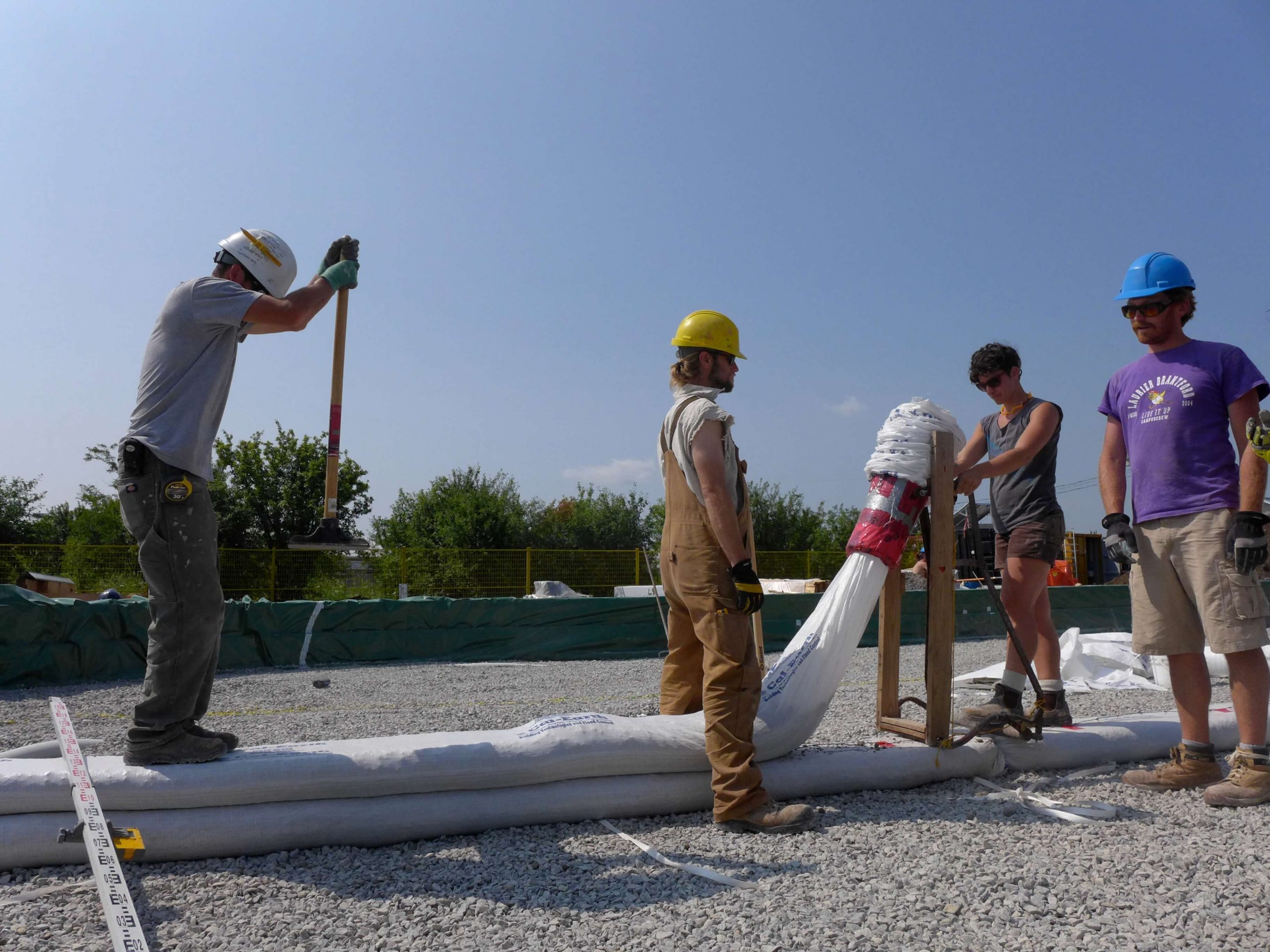
- A crew of three is needed for speedy bagging. One person fills cans with soil mix and tosses them up to a loader, who pours them into the bag. The “shookler” makes sure an even amount of mix goes into the bag.
- All the wall courses of earthbag are completed.
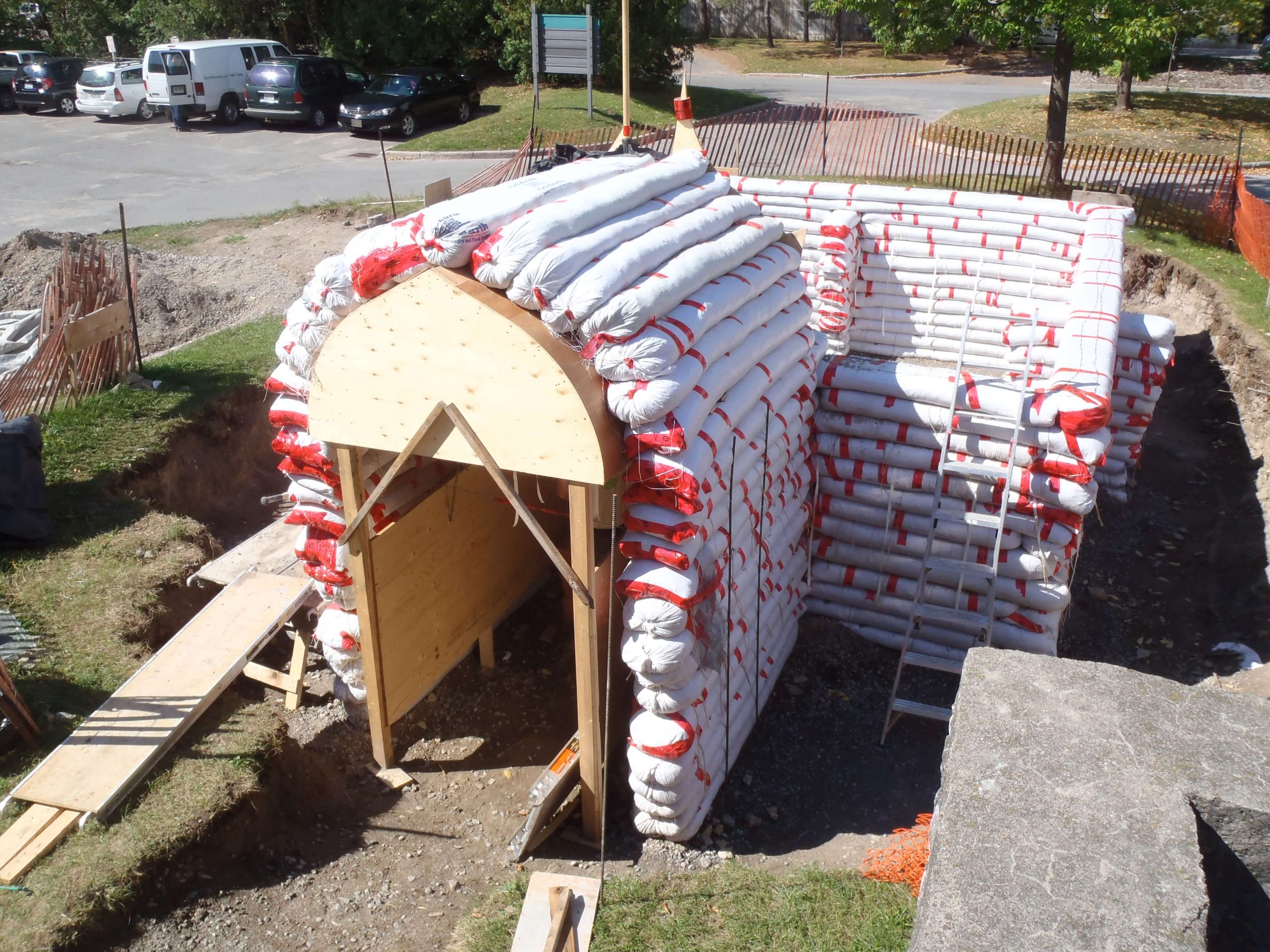
- The earthbags will cooperate to make a stable arch, and the earthbaggers cooperate to stand on the arch as it’s being built!
- The bags on either side of the arch are tamped on an angle to match an imaginary line drawn from the centre point of the arch.
- The final bag of the earthbag arch is the “keystone” and provides a wedge fit between the two sides.
- Proud papa Ben Parkes stands atop the earthbag arch.
- All the structural earthbags are finished, and the exterior is ready to be plastered.
- With the arch completed, the sides of the building are wrapped in recycled plastic drainage dimple board before backfilling begins.
- After the arch is completed, an earthbag retaining wall is built to keep the soil back from the entrance.
- With the top side of the earthbag arch plastered and soil backfilled against the side walls, the formwork is ready to be removed. Will we survive?
- The arched opening beckons…
- With the formwork removed, the bottom side of the earthbags show. This interior arch will get plastered in the next few days.
- A pond liner membrane is used to waterproof the roof. It has less volatile chemicals than regular EPDM roof membrane.
- The backhoe starts to load dirt on top of the roof and the building begins its disappearing act.
- As the root cellar is approached by the footpath or by car traffic, it just looks like a little hill. Once it’s planted in the spring, it will disappear!
- The arched opening and retaining wall hold back the soil that’s buried the building and create the entranceway, which will have a door soon.
- The “dry” room with its earth block floor, plastered earthbag walls and earthblock wall.
- A compressed earth block wall divides the “dry” room from the humid room. The blocks, along with the plasters and the cedar ceiling can all help to regulate interior humidity.
- Three different gargoyles are sculpted into the earthbag buttresses that prevent soil pressure from deforming the wall.
- The earthblock wall is laid up using a clay/sand mortar, and it’s lots of fun to build.
- Don’t worry, the gargoyle isn’t eating him! The earthblock wall goes up next to one of the sculpted buttresses.
- In the “dry” room, a poly barrier separates the floor from the earth below, and a compressed earth block floor is laid over the barrier as the finished floor.
- Both rooms in the root cellar have 65 feet of tubing on the supply air side, so that both winter and summer air will be tempered to ground temperature before entering the root cellar.
- The fresh air inlets for both rooms enter the building at floor level.
- The earth tube exhaust pipes are embedded in the cedar ceiling and stale air will exit from here.
- The earth tube vents exit from the roof gable and will poke out above grade to exhaust air via the use of solar fans.
- The earth tube entrances and exits are all that will show of the root cellar, and they will be hidden by wildflowers in the spring.
Endeavour would like to thank the Seasoned Spoon for the chance to be involved with such a great project. Thanks also to Trent University for accommodating the build.
Tim Krahn of Building Alternatives was the adventurous and participatory structural engineer on the project, and Ben Parkes was the lead builder, with lots of help from Justin McKeiver and lots of volunteers.
We’ll post a final look at the root cellar when it’s all complete.